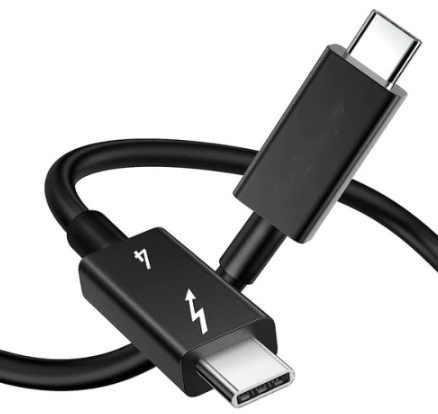
1. How do I know if my laptop has Thunderbolt?
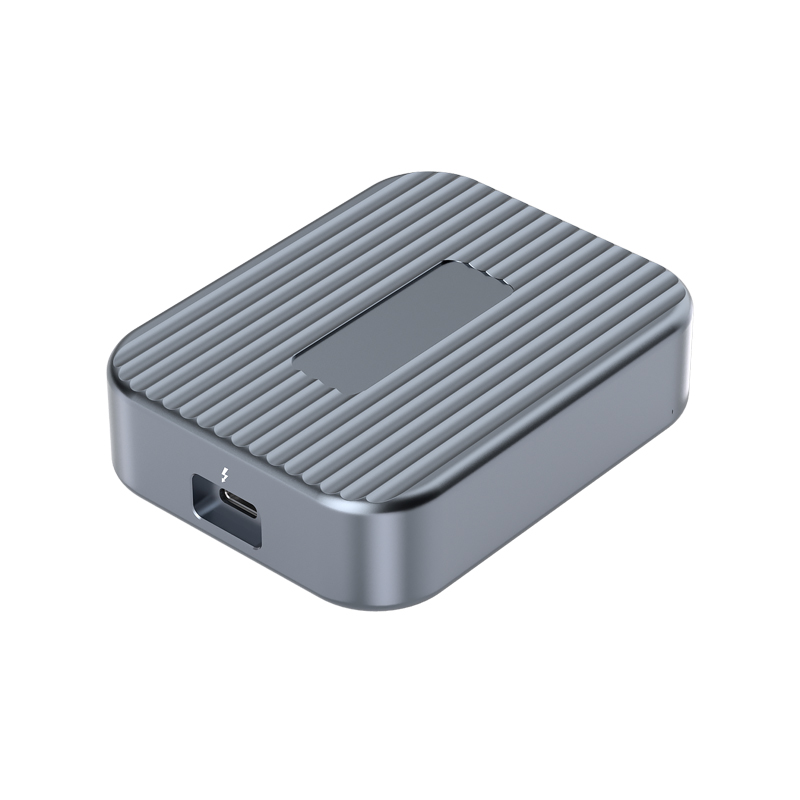
In short: Check your laptop’s official specifications to be sure. Thunderbolt ports can look indistinguishable from USB-C ports since they both use the same physical USB-C connector. In other words, all Thunderbolt ports are USB-C, but not all USB-C ports have Thunderbolt.
Thunderbolt ports should have a small lightning bolt icon for identification. However, some laptop manufacturers use a similar lightning icon to indicate that a USB-C port can charge a phone, not for Thunderbolt. Luckily, most laptops now highlight their Thunderbolt capabilities, so the port should be clearly marked.
In June 2024, Intel announced at a technology conference discussing its Core Ultra 200 (Lunar Lake) processors two key changes it’s mandating for laptop makers: a) consolidating all older USB-C ports on one side of the laptop, away from Thunderbolt ports; b) requiring all ports (including Thunderbolt) to be clearly labeled. This is a small but significant win for users.
USB4, Thunderbolt’s more universal competitor, and Thunderbolt docks are often interchangeable. However, the USB Implementers’ Forum is soon requiring laptop manufacturers to add separate USB4 branding to devices, which I think unnecessarily complicates things.
2. How fast is Thunderbolt?
In short, Thunderbolt 3 or 4 runs at 40Gbps.
Most USB-C ports are based on the USB 3.1 Gen 2 standard with a 10Gbps data transfer speed. Thunderbolt 3 and 4 ports are the most common standards, offering data transfer speeds up to 40Gbps. Thunderbolt 4 differs slightly, theoretically supporting a maximum of 32Gbps for external storage, but you probably won’t notice the difference.
Intel released an 80Gbps version of Thunderbolt in 2024, called Thunderbolt 5, meaning we’ll see more powerful Thunderbolt docks. In some cases, Thunderbolt 5 can reroute data for one-way 120Gbps speeds. As of writing, only about two laptops have announced built-in standalone Thunderbolt 5 chips: versions of the Razer Blade and Maingear ML-17. We’ve also received a Thunderbolt 5 dock for testing.
Additionally, USB 3.2 Gen 2x2 interfaces can pair two 10Gbps channels to create a 20Gbps hub (this really only applies to external gaming-grade SSDs). While most Thunderbolt 3 laptops are designed with four PCIe lanes for 40Gbps total speed, some have only two PCIe lanes, totaling 20Gbps.
3. Which should I buy: Thunderbolt 3, 4, or 5?
Buy a Thunderbolt 3 or 4 dock now. They’re essentially the same, and you can find deals as retailers clear out old Thunderbolt 3 inventory.
Thunderbolt 5 is the 80Gbps version, but it’s backward-compatible with 3 and 4. With only a handful of laptops supporting the spec and just one dock available, Thunderbolt 5 isn’t a concern yet. I’ve even tested a Thunderbolt 5 setup and didn’t love it—though the Thunderbolt ecosystem itself seems to blame early test laptops, not the spec.
To recap: Thunderbolt 3 and 4 are mostly identical, and Thunderbolt 5 won’t be an issue until after 2025.
Think of Thunderbolt 4 as a more restrictive version of Thunderbolt 3, with less room for issues. Both top out at 40Gbps bandwidth, enough for two 4K/60 displays. “Top out” is key: Thunderbolt 3 only needs to support 10Gbps to drive one external 4K display (16Gbps PCIe plus USB 3.2). Most manufacturers exceed this, though—our recommended docks support the full 40Gbps spec (and two 4K displays) unless stated otherwise. Thunderbolt 3 also supports slower 16Gbps PCIe connections for external storage.
Thunderbolt 3 is also the only spec we’ve seen support external GPUs (not Thunderbolt 4), if you want to try that setup.
Thunderbolt 4 leaves no room for compromise—it delivers full 40Gbps functionality (32Gbps PCIe + USB 3.2) without question. For external storage, Thunderbolt 4 supports 32Gbps transfers—which really only matters for video, external GPU connections, or gaming. It also enables “sleep wake” via external keyboards or mice (just tap a key or wiggle the mouse to wake your computer), longer cable lengths, and more Thunderbolt ports.
If you really want to dive into the nuances between Thunderbolt 3, 4, and USB4, device maker Anker created a table detailing all their technical specs (below). What’s USB4? We’ll explore that next.
4. I already have a USB-C dongle. Can I use it with Thunderbolt?
Yes, you can plug dongles into Thunderbolt ports. But a 10Gbps dongle won’t magically become a 40Gbps Thunderbolt port—docks have internal circuitry that lets them work with a laptop’s high-speed Thunderbolt port. That said, nothing stops you from plugging a dongle into a Thunderbolt dock’s available USB-C port. If your laptop has two Thunderbolt ports, you could even connect a Thunderbolt dock to one and a dongle to the other.
5. My laptop has USB4 ports but no Thunderbolt ports. Can I use a Thunderbolt dock with it?
Likely yes. USB4 ports commonly appear on AMD Ryzen-powered laptops. USB4 and Thunderbolt 4 are compatible and functionally identical. (Though Thunderbolt is an open standard, Intel refuses to certify non-Intel hardware—hence Ryzen laptops get USB4 ports, while Intel Core laptops get Thunderbolt.)
USB4 is essentially a subset of Thunderbolt 4, designed primarily as an I/O spec. USB4 devices work fine when plugged into Thunderbolt 4 ports. However, some dock manufacturers say Thunderbolt 4 devices might not work correctly when plugged into dedicated USB4 ports. In reality, most hubs and docks market themselves as Thunderbolt 4, while most devices (like external SSDs) are designed around USB4. (We’ve tested Thunderbolt docks on Thunderbolt laptops, for the record.) USB4 docks do exist, though—you can find them in our best-of lists.
USB4 Version 2 is a standard that will push USB4 to 80Gbps, just like Thunderbolt 5. But I haven’t seen any docks sold as USB v2 (a.k.a. USB80Gbps) yet.
Note that Thunderbolt 3 and 4 require at least 15W to power devices plugged into their ports (like bus-powered hard drives). USB4 only needs half that. I tried plugging a Thunderbolt 5 dock into a USB4 laptop, and it didn’t work—though it should! Likely just a driver issue.
6. Why does Thunderbolt 5 matter?
The Thunderbolt 5 spec boosts I/O bandwidth from Thunderbolt 4’s 40Gbps to 80Gbps (and up to 120Gbps in some cases). Another way to think about Thunderbolt 5 is through its capabilities: Thunderbolt 4 has enough bandwidth for two 4K displays at 60Hz; Thunderbolt 5 can handle three 4K displays at 144Hz. That makes it a gaming-grade technology, not just an office tool.
Thunderbolt 5 also dedicates 64Gbps of bandwidth to storage and external GPUs—double Thunderbolt 4’s 32Gbps. Finally, there’s power: Thunderbolt 5 can deliver up to 240W (with a 140W minimum) for charging your laptop. Most laptops currently need 65W–90W, but gaming laptops require more. That means Thunderbolt 5 docks might let you skip carrying a gaming laptop charger. (Not always, but in some cases!) Just note: You’ll need a laptop that supports this power spec!
Here’s the catch: Thunderbolt 5 debuted in 2024 for both laptops and docks/devices. While we saw a few early products at CES 2024, as of writing, we’ve only seen two TB5 laptops: the Razer Blade and one version of the Maingear ML-17. Both use standalone chips, not integration into the processor. One Thunderbolt 5 dock, the Kensington SD5000T5, has shipped. I tested a Thunderbolt 5 setup that worked poorly, but I blame the Maingear laptop, not the dock.
Why does this matter? If features like Thunderbolt 5 aren’t baked into processors, laptop OEMs have to buy them separately. That takes time, money, and engineering—most laptop makers will think twice before investing extra. While there are plenty of Thunderbolt 5 docks on the horizon, almost no laptops support it yet. At CES, I was told Thunderbolt 5 could take years to go mainstream—probably 2026 or 2027.
Thunderbolt 5 isn’t integrated into Intel’s Lunar Lake mobile processors or Arrow Lake’s desktop/mobile chips yet. Maybe Panther Lake will support it? The first Thunderbolt 5 cables have debuted, though some might be too short for practical use.
7. What is Thunderbolt Share, and how does it work?
Thunderbolt Share is a new way to connect two PCs via a Thunderbolt cable. Plug one end into a Thunderbolt port on one PC, the other end into a Thunderbolt port on another laptop—and boom, they’re connected. Thunderbolt Share lets you control one PC from another, sync files, share files, and more, all at Thunderbolt speeds. I’ve covered and tested Thunderbolt Share here.
It sounds simple, user-friendly, and powerful, but the reality is more complicated. Both computers must run Intel’s Thunderbolt Share software, which you can only get on authorized PCs or via Thunderbolt docks. Thunderbolt 4 and 5 support Thunderbolt Share, but Thunderbolt 3 does not—at least officially. The same goes for USB4; it might support it, or it might not. Intel isn’t saying.
Thunderbolt Share will get support from a handful of PC makers and dock manufacturers like Belkin and Plugable. But here’s the thing: This announcement came and went quickly. Right now, I don’t see Thunderbolt Share as anything more than a gimmick. I didn’t even see it at CES 2025.
Virtually every Thunderbolt dock comes with its own cable. We recommend using Thunderbolt 3 cables with Thunderbolt 3 products, Thunderbolt 4 cables with Thunderbolt 4 products, and so on for the first Thunderbolt 5 cables (due in 2024).
9. My Thunderbolt dock only has Thunderbolt ports, but I need to connect it to an HDMI monitor. How do I connect a Thunderbolt dock to an HDMI display?
You’ll need a dedicated USB-C to HDMI cable rated for Thunderbolt. I recommend the Uni Thunderbolt to HDMI cable, which I’ve bought on Amazon for around $16. You can find cheaper options, but make sure they’re rated for Thunderbolt or 4K@60Hz displays.
10. What’s the difference between a DisplayLink USB-C dock and a Thunderbolt dock?
DisplayLink USB-C docks are a new breed of dock. Unfortunately, they’re often just called “USB-C docks,” even though the DisplayLink logo is prominent on the box. The key is that DisplayLink technology (now owned by Synaptics) compresses data between your PC and the dock to deliver a near-Thunderbolt experience (a pair of 4K 60Hz displays, plus other peripherals) over narrower, slower USB-C buses. You need to install software drivers on your PC to communicate with the dock’s built-in DisplayLink chip.
This has a twofold benefit. First, DisplayLink lets you “cheat” and use a Thunderbolt-like dock on older laptops. Second, even if you have a Thunderbolt-enabled laptop, you might find cheaper DisplayLink USB-C docks than Thunderbolt ones. It’s a viable solution, especially if you don’t care about PC gaming.
Our separate coverage of DisplayLink docks has more details.
11. What is HBR3 with DSC?
We’re starting to see some USB-C docks leverage another technology: HBR3 (High Bit Rate 3.0) and DSC (Display Stream Compression). Think of it as the industry-standard, manufacturer-agnostic version of DisplayLink. It works over USB-C ports and again delivers a dual 4K60 display experience.
The problem? It’s finicky. We’ve found support spotty on 11th-gen hardware but more stable on 12th- or 13th-gen Core laptops (and newer, out of the box). Still, it’s becoming more common and runs more smoothly on the latest Intel Core laptops.
12. Can I use an external GPU (eGPU) with Thunderbolt?
With a Thunderbolt 3 port, yes. Some manufacturers (Razer, for one, and others) make cases that hold standard desktop GPUs and connect to laptops via Thunderbolt cables. While mobile gaming laptops with external GPUs work well for on-the-go gaming, desktop GPUs perform even better. Thunderbolt just bridges the two.
External GPU support seems to have skipped Thunderbolt 4, so I’d recommend a Thunderbolt 3 dock or waiting for Thunderbolt 5. How to connect an eGPU to a laptop via Thunderbolt? Our story has more.
13. The only eGPUs I’ve seen with Thunderbolt use Thunderbolt 3, not 4. Why is that?
A Razer representative put it simply: The differences between Thunderbolt 3 and 4 are too minor. “When we release anything, it’s only when there’s a substantial advantage over the previous generation.”
Since Thunderbolt 4 is backward-compatible and functionally identical to 3, Razer saw no point in investing in Thunderbolt 4 eGPU production or testing. We suspect other manufacturers will follow suit.