1. Technical Evolution: The Core Logic of Breaking Traditional Storage Bottlenecks
In modern high-performance computing systems, the read/write speed of storage media is often the decisive factor in system response speed. The proliferation of PCIe Solid State Drives (PCIe NVMe SSDs) has fundamentally resolved the bandwidth bottlenecks caused by the traditional SATA protocol. Unlike mechanical hard drives and early SATA SSDs, PCIe SSDs communicate directly with the CPU via the computer bus, utilizing the NVMe (Non-Volatile Memory express) protocol to significantly reduce latency.
Data indicates that mainstream PCIe 4.0 SSDs can achieve sequential read speeds of over 7000MB/s. This not only significantly shortens operating system boot times but also demonstrates an overwhelming advantage in large-scale 3D rendering, 4K video editing, and loading AAA gaming scenarios. For workstation users and e-sports players pursuing ultimate response speed, the PCIe channel has become the standard configuration for storage.
2. Interface Analysis: The Real Relationship Between M.2 and PCIe
There is often a misunderstanding in the market regarding "M.2 vs. PCIe," but in reality, they belong to different conceptual dimensions. M.2 refers to the physical interface standard (form factor), while PCIe is the data transmission channel.
SATA Protocol M.2 SSD: Although it uses the M.2 interface, it is limited by the SATA channel, with a speed cap of only 560MB/s.
NVMe Protocol M.2 SSD (Commonly called PCIe SSD): Uses the M.2 interface and runs on the PCIe channel, unleashing the full performance potential of the flash memory particles.
Therefore, when selecting high-performance storage, one must not only look for the M.2 interface but also confirm whether it supports the PCIe NVMe protocol. This is the key indicator that determines throughput and IOPS (Input/Output Operations Per Second).
3. Performance Extension: Building a High-Speed Mobile Storage Ecosystem
With the iteration of PCIe SSD capacity and speed, users often face two scenarios: first, dealing with idle, small-capacity NVMe SSDs left over after a computer upgrade; second, the need to bring PCIe-level read/write speeds out of the chassis to achieve high-speed asset transfer across devices.
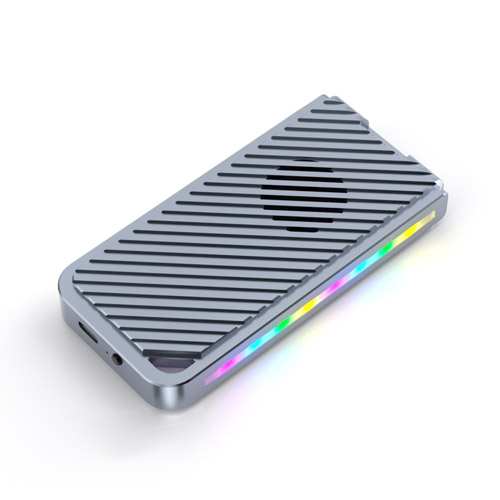
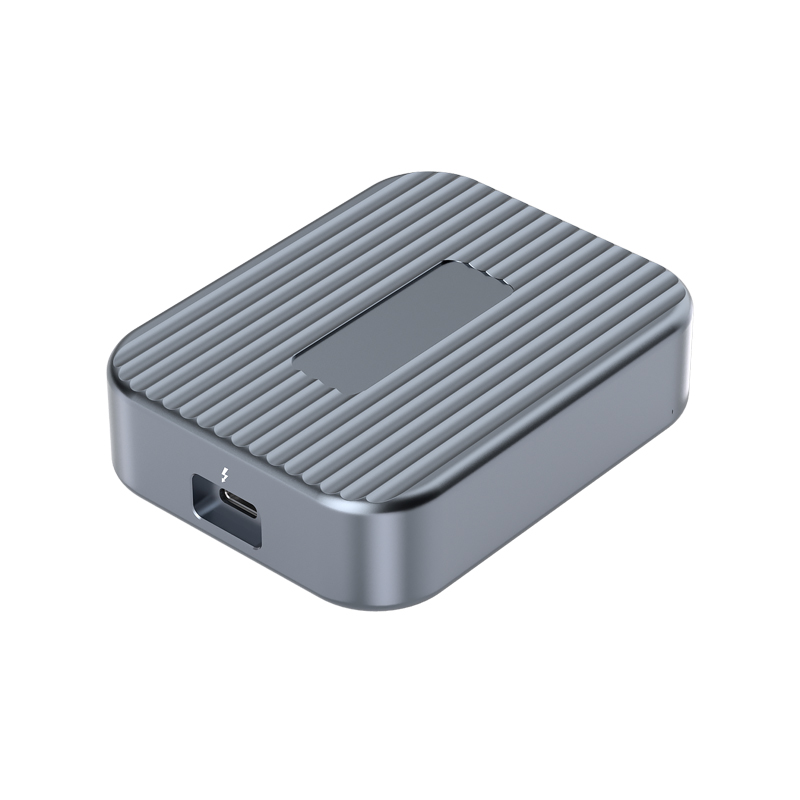
At this point, the Hard Drive Enclosure becomes the bridge connecting internal high-performance components with external portability needs. Unlike traditional USB flash drives, by installing a PCIe SSD into a professional M.2 mobile hard drive enclosure, one can instantly construct a PSSD (Portable Solid State Drive) with read/write speeds breaking through 1000MB/s or even 2000MB/s (depending on USB/Thunderbolt interface bandwidth).
4. Key Decision: How to Unleash PCIe Performance via a Hard Drive Enclosure
Not all casings can support the high performance of PCIe SSDs. Choosing the wrong hard drive enclosure can lead to transmission throttling or disconnection due to overheating. Constructing an efficient external storage solution requires attention to the following technical indicators:
Protocol Compatibility: You must select a hard drive enclosure that supports the NVMe protocol. If you mistakenly choose an enclosure that only supports the NGFF (SATA) protocol, the PCIe SSD will not be recognized.
Bridge Chip & Interface Bandwidth: To avoid bottlenecks, it is recommended to choose a hard drive enclosure equipped with high-end master control chips (such as Realtek or ASMedia series). The interface standard should be at least USB 3.2 Gen2 (10Gbps) or USB 3.2 Gen2x2 (20Gbps) to match the high throughput of PCIe solid-state drives.
Passive Cooling Design: PCIe SSDs generate significant heat when running at full speed. A high-quality hard drive enclosure must feature a full aluminum alloy body and be equipped with high-thermal-conductivity silicone pads, utilizing the metal shell as a heatsink to prevent the SSD from triggering its speed-throttling protection mechanism due to high temperatures.
Summary
In summary, PCIe NVMe technology has established the performance benchmark for modern storage. Meanwhile, external expansion via a high-performance mobile hard drive enclosure is the best practice for maximizing this technological dividend and achieving free data flow. Whether for repurposing old hardware or building productivity tools, the combination of "PCIe SSD + Professional Hard Drive Enclosure" offers an efficiency experience far superior to traditional mobile storage.